For centuries, diamonds have fascinated us with their brilliance, rarity, and unmatched sparkle. But did you know that every natural diamond is evaluated using an international method known as the 4Cs? These are the four main characteristics of a diamond: Carat (weight), Color, Clarity, and Cut.
The 4Cs are essential for determining a diamond’s quality and market value. Whether you’re assessing a stone, buying an HSI diamond jewel, or trying to understand what justifies the price of a white diamond, knowing how to evaluate these four characteristics is key.
In this article, we explore in detail each of the diamond’s characteristics, with concrete examples, diamond grading charts, and expert tips to help you choose the perfect diamond according to your preferences and budget. Whether it’s for a bracelet, a ring, or a pendant, understanding diamond quality will help you make a smart and lasting choice.
What Are the 4Cs of Diamonds?
The 4Cs represent the four fundamental criteria used internationally to grade diamonds. Defined by the renowned Gemological Institute of America (GIA), this system provides a universal standard for evaluating diamond quality. The criteria are:
- Carat (diamond weight)
- Color (diamond hue)
- Clarity (diamond purity)
- Cut (diamond shape and proportions)
Each diamond characteristic influences not only its value, but also its visual beauty and brilliance. Two diamonds of the same weight can vary greatly in price depending on their color, clarity, or cut quality.
This system allows both buyers and professionals to evaluate a diamond objectively. Thanks to the 4Cs, it’s possible to compare diamonds on reliable, standardized criteria and understand the distinctions between different diamond grades.
1. Carat: The Weight of the Diamond
Carat is the unit used to measure a diamond’s weight. One carat equals 0.20 grams, and it’s often the first factor people look at when purchasing a natural diamond.
At equal quality, the heavier the diamond, the more valuable it becomes. For example, a 1-carat diamond will be significantly more expensive than a 0.50-carat diamond if both have the same color, clarity, and cut.
However, carat weight alone does not define quality. It must always be considered alongside the other three characteristics for a complete diamond evaluation.
Here’s a diamond size chart showing the relationship between carat and dimensions for a round diamond:
Carat | Approx. Diameter (mm) | Visual Appearance |
0.25 | 4.1 mm | Subtle, ideal for delicate settings |
0.50 | 5.1 mm | Elegant and balanced |
1.00 | 6.5 mm | Classic and prestigious size |
1.50 | 7.4 mm | Strong visual impact |
2.00 | 8.2 mm | Rare and striking |
Diamonds of equal carat weight are often compared using the other quality criteria, such as color (D to Z) and clarity (IF to I1). Carat is just one piece of the puzzle in the overall diamond grading process.
2. Color: From Pure White to Yellow Tints

GIA Color Scale (D to Z)
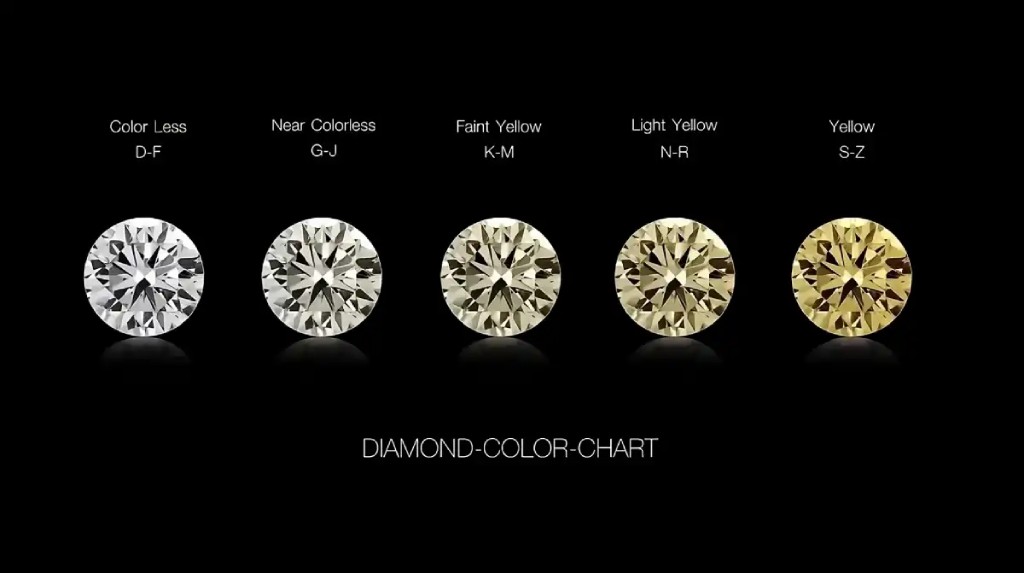
The color of a diamond is one of the most subtle characteristics to assess. The GIA (Gemological Institute of America) has established a standardized color grading scale ranging from D (colorless) to Z (noticeable yellow tint).
The closer a diamond is to D, the rarer and more valuable it is. Conversely, a diamond closer to Z will show a visible yellow hue, which can affect its perceived quality and price.
Letter | Classification | Appearance |
D – F | Colorless | Pure white, very rare |
G – J | Near Colorless | Slight yellow tone |
K – M | Faint Tint | Noticeable pale yellow |
N – R | Very Light Tint | Light yellow |
S – Z | Noticeable Tint | Strong visible yellow |
For the untrained eye, the difference between two adjacent grades (e.g., D vs. E) may be nearly invisible. Only expert gemologists, using controlled lighting conditions, can accurately distinguish these subtle differences. That’s why diamond grading charts are used to simplify the evaluation process.
Lastly, note that fancy colored diamonds (pink, blue, green, black, etc.) are not graded on this scale, as they belong to a separate category in diamond classification.
Why Is Color Important?
The color of a diamond directly impacts its brilliance, value, and its harmony with the metal in which it is set. For example:
- A white diamond (grades D to F) pairs beautifully with white gold or platinum, enhancing its icy sparkle.
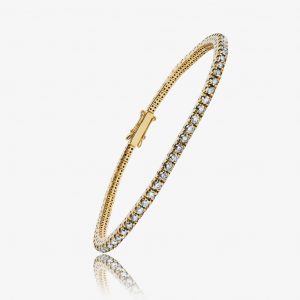
- A slightly tinted diamond (grades G to J) can be beautifully complemented by a yellow gold setting, which softens the hue and creates an elegant contrast.
Tip:
If you’re on a budget, a diamond with a G or H color grade often provides the best balance between visual quality and price, with no noticeable loss of brilliance to the naked eye.
3. Clarity: The Purity of the Diamond

What Are Inclusions?
All diamonds — even the rarest — contain inclusions, which are tiny internal imperfections such as:
- Foreign crystals
- Small cracks or fractures
- Black spots
These imperfections form naturally during the diamond’s crystallization process deep within the Earth. They don’t always affect the stone’s beauty, especially when they are not visible to the naked eye.
A diamond is classified as “loupe-clean” (FL – Flawless or IF – Internally Flawless) when no inclusions are visible under 10x magnification, the standard in gemology.
GIA Clarity Grading Scale
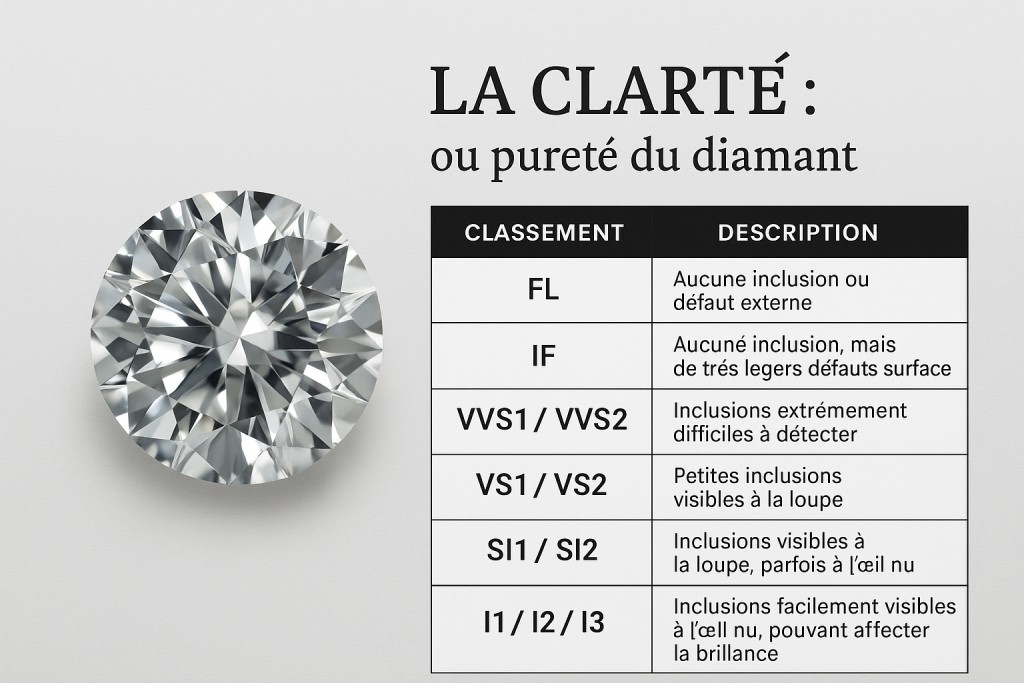
The following table shows the internationally recognized GIA clarity scale, used to assess diamond purity:
Code | Meaning | Description |
FL | Flawless | No internal or external flaws |
IF | Internally Flawless | No inclusions, only minor surface blemishes |
VVS1 / VVS2 | Very Very Slightly Included | Inclusions extremely difficult to detect |
VS1 / VS2 | Very Slightly Included | Small inclusions visible under magnification |
SI1 / SI2 | Slightly Included | Inclusions visible with a loupe, sometimes to the naked eye |
I1 / I2 / I3 | Included | Clearly visible inclusions that may affect brilliance |
For most fine jewelry, a clarity grade between VS1 and SI1 offers an excellent balance of quality and value with no noticeable impact on the stone’s appearance.
4. Cut: Brilliance Shaped by Human Hands
Cut vs. Shape of the Diamond
It’s essential to distinguish between a diamond’s cut and its shape:
- Shape refers to the diamond’s visible outline — round, princess, cushion, pear, emerald, and so on.
- Cut, on the other hand, refers to the quality of the craftsmanship — how precisely the stone has been cut and faceted.
Among all the diamond characteristics, cut is the only one influenced by humans. Even if a diamond has excellent carat, color, and clarity, a poor cut will significantly diminish its brilliance.

GIA Cut Grading Scale
The GIA grades cut quality on five levels:
Grade | Cut Quality | Visual Result |
Excellent | Optimal light reflection | Maximum brilliance |
Very Good | Very good brilliance | Slight light loss |
Good | Decent brilliance | Less fire and sparkle |
Fair | Reduced brilliance | Noticeable loss of light |
Poor | Poor craftsmanship | Dull and unbalanced appearance |
A well-executed cut maximizes light reflection through the diamond’s facets, giving the stone its iconic fire and sparkle.
The Importance of a Diamond Certificate
When buying a natural diamond — whether for a gold bracelet or a ring — it is essential to request a diamond certificate issued by an independent, internationally recognized lab, such as GIA, HRD, or IGI.
Why Demand a GIA or Equivalent Certificate?
A diamond certificate is like the stone’s identity card. It guarantees the quality of the diamond and protects the buyer by ensuring that the 4Cs — carat, color, clarity, and cut — have been objectively assessed by professionals.
What does a certificate include?
- The diamond’s exact carat weight
- Its color and clarity based on GIA scales
- The cut quality
- Precise dimensions
- Any fluorescence
- A laser inscription number for authentication
Without a certificate, you run the risk of buying an overpriced, misgraded, or even synthetic or treated diamond unknowingly. Many fake or low-quality stones circulate without any traceability.
At Bracelets Kern, we are committed to offering only certified diamonds, ensuring complete transparency and uncompromising excellence in every piece of jewelry we create.
Which Diamond Should You Choose for Your 9K Gold Bracelet?
A 9K gold bracelet is an affordable, durable, and elegant choice — especially when adorned with a carefully selected diamond. But how do you balance aesthetics and diamond quality in such a refined piece?
-
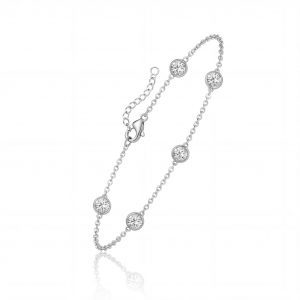
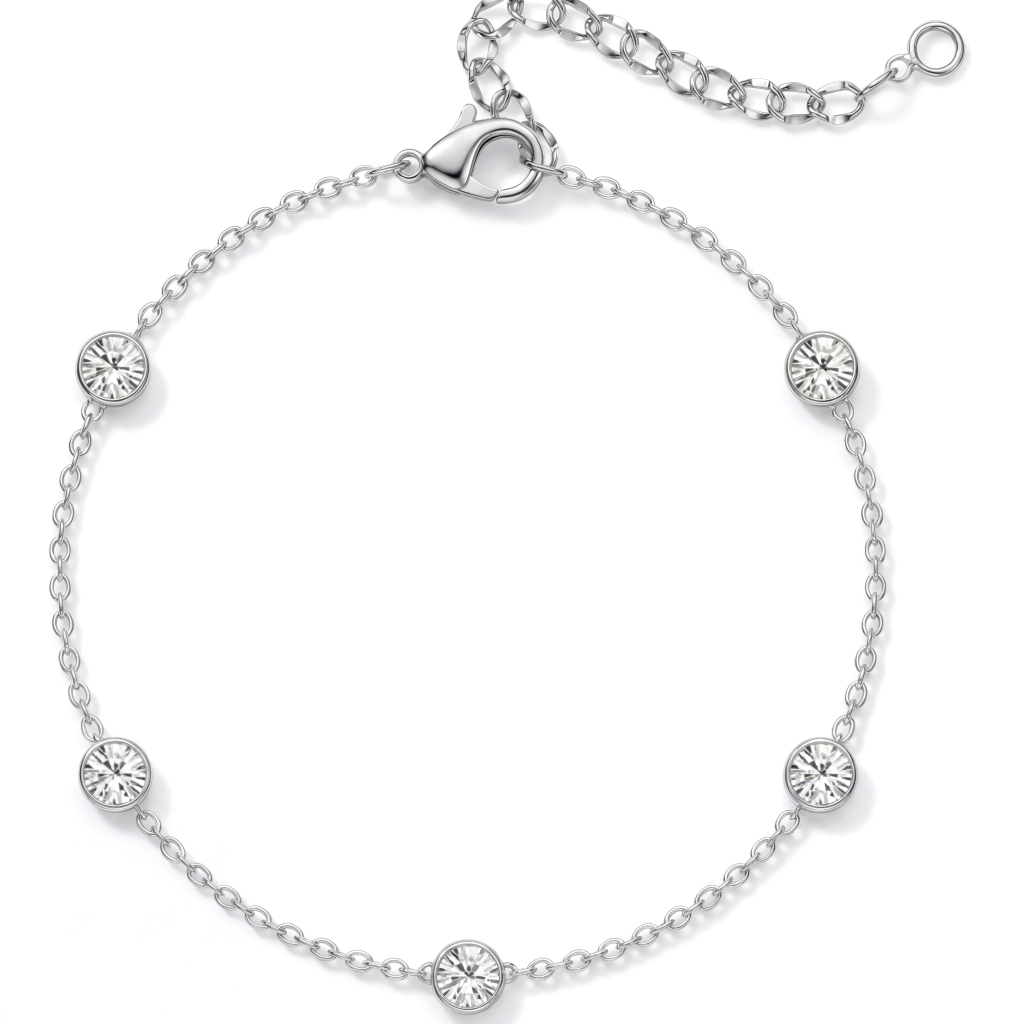
Aurora Crystal White Diamond Bracelet – Rhodium-Plated 925 Sterling Silver
The Aurora Crystal White Diamond Bracelet in rhodium-plated 925 sterling silver stands out for its delicate design and subtle brilliance. Adorned with bezel-set crystals, it captures the light with elegance for a refined finish. Its fine, adjustable chain (16 + 5 cm) fits perfectly on all wrists, offering everyday comfort and lightness. Timeless and versatile, it can be worn alone or layered to enhance any outfit.
SKU: BRAC-AURORA-DB-AB Categories: All articles, HER149€99€ -
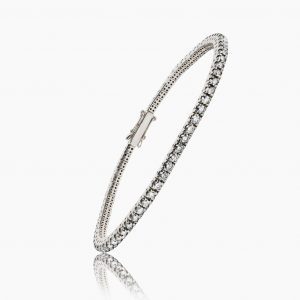
White Diamond Crystal Bracelet – White Rhodium-Plated 925 Sterling Silver
Bracelet in white rhodium-plated 925 sterling silver, set with white diamond crystals, and featuring a double safety clasp.
SKU: BRAC-PURET-DB-OB-1 Categories: All articles, HER, HIM, Purity Collection149€ -
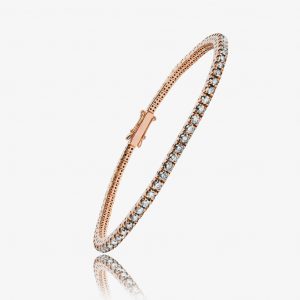
White Diamond Crystal Bracelet – Rose Rhodium-Plated 925 Sterling Silver
Bracelet in rose rhodium-plated 925 sterling silver, set with white diamond crystals, and featuring a double safety clasp.
SKU: BRAC-PURET-DB-OR-1 Categories: All articles, HER, HIM, Purity Collection149€ -
White Diamond Crystal Bracelet – Yellow Rhodium-Plated 925 Sterling Silver
Bracelet in yellow rhodium-plated 925 sterling silver, set with white diamond crystals, and featuring a double safety clasp.
SKU: BRAC-PURET-DB-OJ-1 Categories: All articles, HER, HIM, Purity Collection149€
The goal is to strike the right balance between the 4Cs (carat, color, clarity, and cut) and your budget. It’s better to choose a slightly smaller diamond with an excellent cut than a larger one with poor grading.
Our Selection of Diamond Bracelets in 9K Gold
At Bracelets Kern, we’ve curated a collection of gold bracelets set with certified natural diamonds, combining refinement, style, and authenticity. Our creations suit both feminine wrists and masculine styles.
-
White Diamond Crystal Bracelet – White Rhodium-Plated 925 Sterling Silver
Bracelet in white rhodium-plated 925 sterling silver, set with white diamond crystals, and featuring a double safety clasp.
SKU: BRAC-PURET-DB-OB-1 Categories: All articles, HER, HIM, Purity Collection149€ -
White Diamond Crystal Bracelet – Rose Rhodium-Plated 925 Sterling Silver
Bracelet in rose rhodium-plated 925 sterling silver, set with white diamond crystals, and featuring a double safety clasp.
SKU: BRAC-PURET-DB-OR-1 Categories: All articles, HER, HIM, Purity Collection149€ -
White Diamond Crystal Bracelet – Yellow Rhodium-Plated 925 Sterling Silver
Bracelet in yellow rhodium-plated 925 sterling silver, set with white diamond crystals, and featuring a double safety clasp.
SKU: BRAC-PURET-DB-OJ-1 Categories: All articles, HER, HIM, Purity Collection149€ -
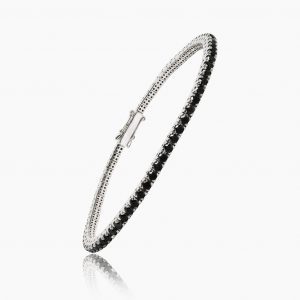
Synthetic Black Diamond Bracelet – White Rhodium-Plated 925 Sterling Silver
Bracelet in white rhodium-plated 925 sterling silver, set with synthetic black diamonds, and featuring a double safety tongue clasp.
SKU: BRAC-ELÉGA-DN-OB-1 Categories: All articles, HIM, Strength & Elegance Collection149€
Each bracelet is carefully crafted and assembled according to the highest quality standards.
FAQ – Everything You Need to Know About the 4Cs of Diamonds
What do the 4Cs mean in diamond evaluation?
The 4Cs represent the four key criteria used to grade a diamond:
- Carat: the weight of the stone
- Color: its hue, from D (colorless) to Z (noticeable yellow)
- Clarity: its purity, or level of inclusions
- Cut: how well it’s cut, directly affecting brilliance
These characteristics determine a diamond’s value, beauty, and rarity.
What’s the highest grade a diamond can receive?
A perfect diamond would have:
- 1 carat or more
- D color (colorless)
- FL clarity (Flawless)
- Excellent cut according to the GIA
However, the best diamond depends on the value-for-money ratio you’re seeking.
What carat weight should I choose for a 9K gold bracelet?
For a delicate or subtle bracelet, choose a diamond between 0.10 to 0.30 carat
For a bolder style, especially a men’s bracelet, go for 0.40 to 0.50 carat
Ideally, pick a diamond with a Very Good or Excellent cut to maximize brilliance.
Does diamond color significantly affect the price?
Yes. A white diamond (D to F) is much rarer and more expensive than a slightly tinted diamond (G to J).
For a good balance between aesthetic and budget, G or H color grades are often the most recommended.
What Does “Loupe-Clean” Diamond Mean?
A diamond is considered loupe-clean (graded FL – Flawless or IF – Internally Flawless) when no inclusions (internal flaws) are visible under 10x magnification.
These are the purest diamonds — but also the rarest and most expensive.
What Is a Diamond Certificate For?
A diamond certificate (from GIA, HRD, IGI, etc.) guarantees the authenticity and quality of the 4Cs. It also includes:
- Exact dimensions
- Fluorescence level
- And sometimes a laser inscription with a unique ID number
Without a certificate, you can’t be certain of the diamond’s true value.
Do All Diamonds Come with a Certificate?
No. Smaller diamonds (often< under 0.30 carat) are not always certified.
However, at Bracelets Kern, we favor certified diamonds even for fine jewelry — ensuring full traceability and uncompromising quality.
How to Balance Diamond Quality and Budget?
Focus on the most visually noticeable criteria:
- Excellent or Very Good cut
- G to H color
- VS or SI1 clarity
Then, adjust the carat weight based on your budget. This combination often provides maximum brilliance without exceeding your price range.